Filming HYROX at Olympia London
Filming a personal trainer through a HYROX race at Olympia London. Ninety minutes, eight stations, and a film, a set of social clips and edited stills delivered from it.
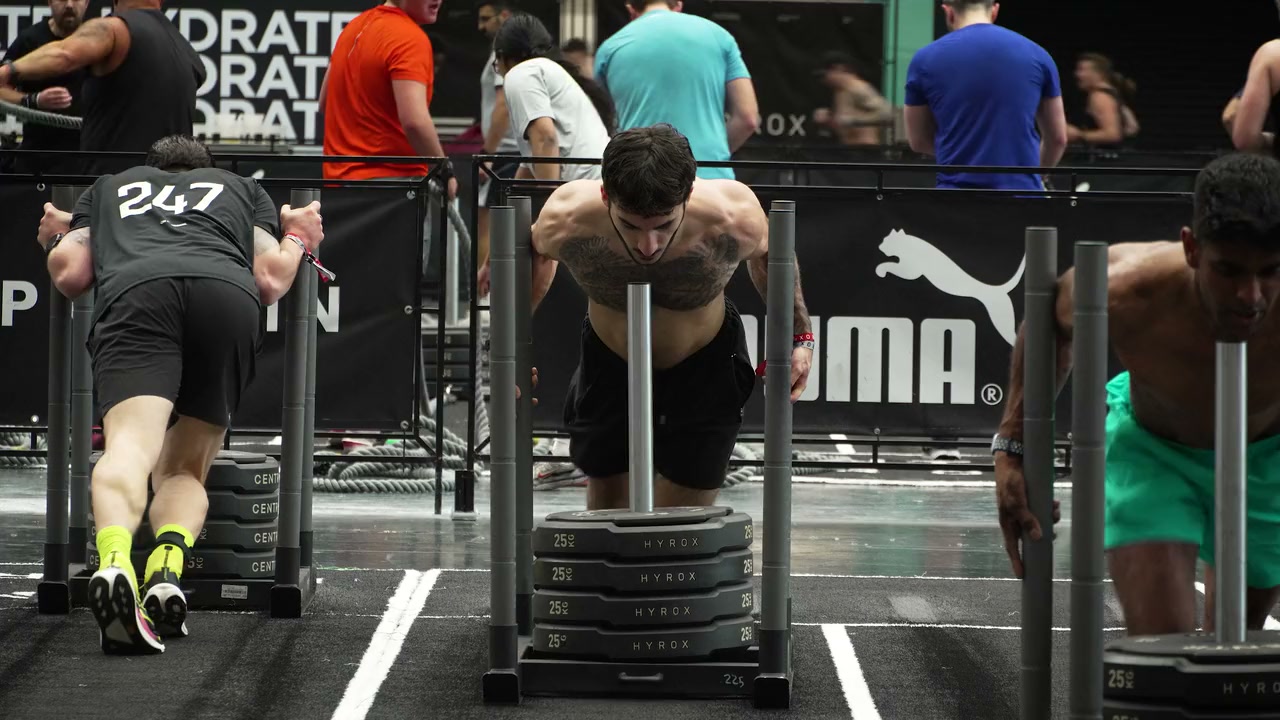
Fabio Mendes, a personal trainer, raced the Open division at HYROX London. He wanted content out of it. That meant eight stations, eight kilometres of running, ninety minutes on the floor, one operator working from the spectator side of the barriers, and a set of files he could post that week.
The job
- Client: Fabio Mendes, personal trainer
- Event: HYROX Open division, Olympia London, March 2026
- Access: spectator, no media pass
- Time on the floor: 90 minutes, start to finish line
- Camera: Sony A6700, 18-135mm, XAVC S 4K, 4:2:2 10-bit, 25fps at 1/50, S-Cinetone
- Delivered: a 2:37 film, individually graded clips cut for social, and edited action stills
What the client got
A race is not one piece of content, so it was not delivered as one.
The film. 2:37, cut to a single track, graded, mixed and exported at 4K. This is the piece that tells the story of his race: the warmup, the eight stations, the finish, and him flat on the floor afterwards.
Clips for social. Individually trimmed and individually graded, delivered as full 4K horizontal. That last part is a decision rather than a default, and it is explained further down.
Stills. Shot in burst at 11 frames a second through the heavy stations, then edited. Holding the shutter for two or three seconds through a sled push gives twenty to thirty frames of the same effort, and one of them always has the body position and the face that the other twenty-nine do not.
“Bro those images look so sick such good quality.”
Reading the race before it starts
HYROX runs eight stations in a fixed order with a one kilometre run between each one. That structure is the whole shooting plan, because it tells you exactly how much time you have to move and exactly where the subject will be when you get there.
The run between stations is the window. It is five to seven minutes, and it is the only time to reposition. So the plan was to commit to four or five stations properly rather than sprint between all eight and come back with something rushed from each.
The other rule was to film the full effort at every station and never leave early to get ahead. The end of a station is where it shows: the last few metres of the sled push, the final reps of wall balls, the face at the point where it starts to cost something. Leaving early to secure the next position means trading the best footage of one station for mediocre footage of the next.
Working the light
Olympia’s Grand Hall has a glass barrel roof from 1886 and floods with daylight when it is empty. HYROX fills the floor with barriers, screens, branded structures and its own overhead rigs, which fragments that light and blocks most of it from reaching the athletes. The event also ran across two halls with visibly different light, and the warmup room upstairs was a third environment again.
The zoom opens to f/5.6 at the long end, which sets a hard ceiling on how much light the lens can gather. That leaves shutter speed and ISO, and only one of them is safe to give away.
Shutter speed was protected and ISO was allowed to climb. Stills stayed at 1/800 to freeze the action; where that left the frame dark, the ISO went up rather than the shutter coming down. Noise is a post-production problem and modern denoise handles it while keeping the detail in a face and a rope. Motion blur is permanent. A clean, noiseless photograph of a blurred arm is not a photograph of the athlete.
Holding one athlete in a crowd of hundreds
The technical problem at an event like this is not exposure, it is keeping focus on the one person who is being paid for while several hundred others move through the frame.
Two autofocus settings do that work together, and they pull in opposite directions on purpose:
- AF Transition Speed at 5 of 7. How fast focus returns after something blocks the subject. At HYROX, judges and other athletes cross constantly, so reacquisition needs to be immediate.
- AF Subject Shift Sensitivity at 2 of 5. How willing the camera is to abandon the subject for someone nearer or newer. Low keeps it stubborn.
Fast to come back, slow to leave. The other habit that matters is tracking the torso rather than the face, because a torso stays visible when an athlete drops their head into a station, and a face does not.
Not everything the crowd does is a problem. One of the strongest shots in the film has five people crossing the foreground completely out of focus with Fabio sharp behind them, revealed as they clear the frame. That reads as a planned rack focus. It was the room doing it.
The edit
Three lighting environments meant three separate colour corrections rather than one look pushed across everything: the warmup room against a white wall, the darker hall holding stations one to seven, and the lighter hall with the final station and the finish.
The cut is built on the track before any footage goes down. Every drop and transition in the music gets marked first, and those marks become the cut points, so the film inherits the track’s structure instead of fighting it.
Clip order follows energy, not chronology. Nobody watching knows what order the stations came in. They only feel whether the intensity is climbing. So the warmup opens it, the finish closes it, and everything between is arranged by how hard it looks rather than when it happened.
The arena stays in the mix. The music sits at -6dB and the clip audio underneath at -12dB, so the thuds and the crowd are present without competing. Where people were actually cheering him through a station, the crowd is lifted to -3dB and the music steps back for a moment.
Delivering for social
The clips are delivered as full 4K horizontal, and the framing is built for it during the shoot rather than fixed afterwards.
A 4K horizontal frame is 3840x2160. The centre strip of it, cropped to 9:16, is 1080x1920, which is exactly what TikTok and Reels want. Crop from a 4K master and the pixels are already there, so it stays sharp with no upscaling.
That only works if the subject was framed centrally while filming. Put an athlete on a thirds line and the vertical crop cuts them in half. So anything intended for social is centre framed on the day, which lets the client crop it themselves in whatever app they use and get a native resolution vertical out of it.
Working with me
This is the kind of job the setup suits: one operator, spectator access, a fixed window, and a client who needs a film for the record and clips they can actually post. Race day, gym session, training block or event.
Get in touch if you want something filmed.